
-
Learn to
Raise ToucansGet acquainted with our breeding protocol and learn how to successfully raise your own toucans.
Toucans & Their Captive Reproduction
The following information offers guidelines specific to breeding toucans successfully. For essential information on caring for toucans in general, including in-depth information on diet, health, and safety, visit our Toucan Care page.
Why Breeding Matters
Toucans have long captivated our attention with their disproportionately large, colorful beaks and bright, beautiful feathering. They are the quintessential symbols of the "tropical paradise" many of us long to visit. Our fascination with toucans runs the gamut from breakfast cereal logos to refrigerator magnets, yet we see very few in zoos and private collections. And what few species of toucans there are in our avicultural enclaves now are doubtful to remain there long into the future. In the wild, ten species are currently listed as threatened or near-threatened, and many are in danger of habitat loss. Captive reproduction can help keep toucans in our lives and in our rainforests, contributing to conservation and preservation initiatives.
Breeding toucans is both exciting and fun, and very important if we wish to continue to have toucans in our lives. While there are currently very few breeders, maintaining and breeding toucans in captivity is neither difficult nor tedious and requires no more work than is required of parrot breeding. There are several areas that require particular attention to detail, which include housing, compatibility of pairs, diet, and care of offspring. With the right knowledge and commitment, anyone can help preserve these magnificent birds.
Mate Compatibility
The first step in breeding toucans is to acquire a compatible pair. If an established pair is not available, you can take your chances and buy two individuals of the opposite sex and same species, and try to acclimate them together. As with other monogamous birds, toucans must be compatible with their mates for successful breeding to occur. When two birds are first introduced to each other, they may ignore each other, take immediately to each other, or fight intensively. It is imperative that the birds are monitored closely the first few days to ensure they do not fight. Introductions should be done in the morning to allow plenty of time for observation, and give the birds a chance to acquaint themselves with their new companion.
Fighting: If the birds begin to fight, it may not last more than a few minutes. Some minor squabbling and beak jousting is normal at first. However, if they persist, the birds must be separated to avoid serious injury or death. In that event, they should be separated for several days before attempting to reintroduce them to each other at a later date. If the pairing is unsuccessful, different mates must be selected for each bird.
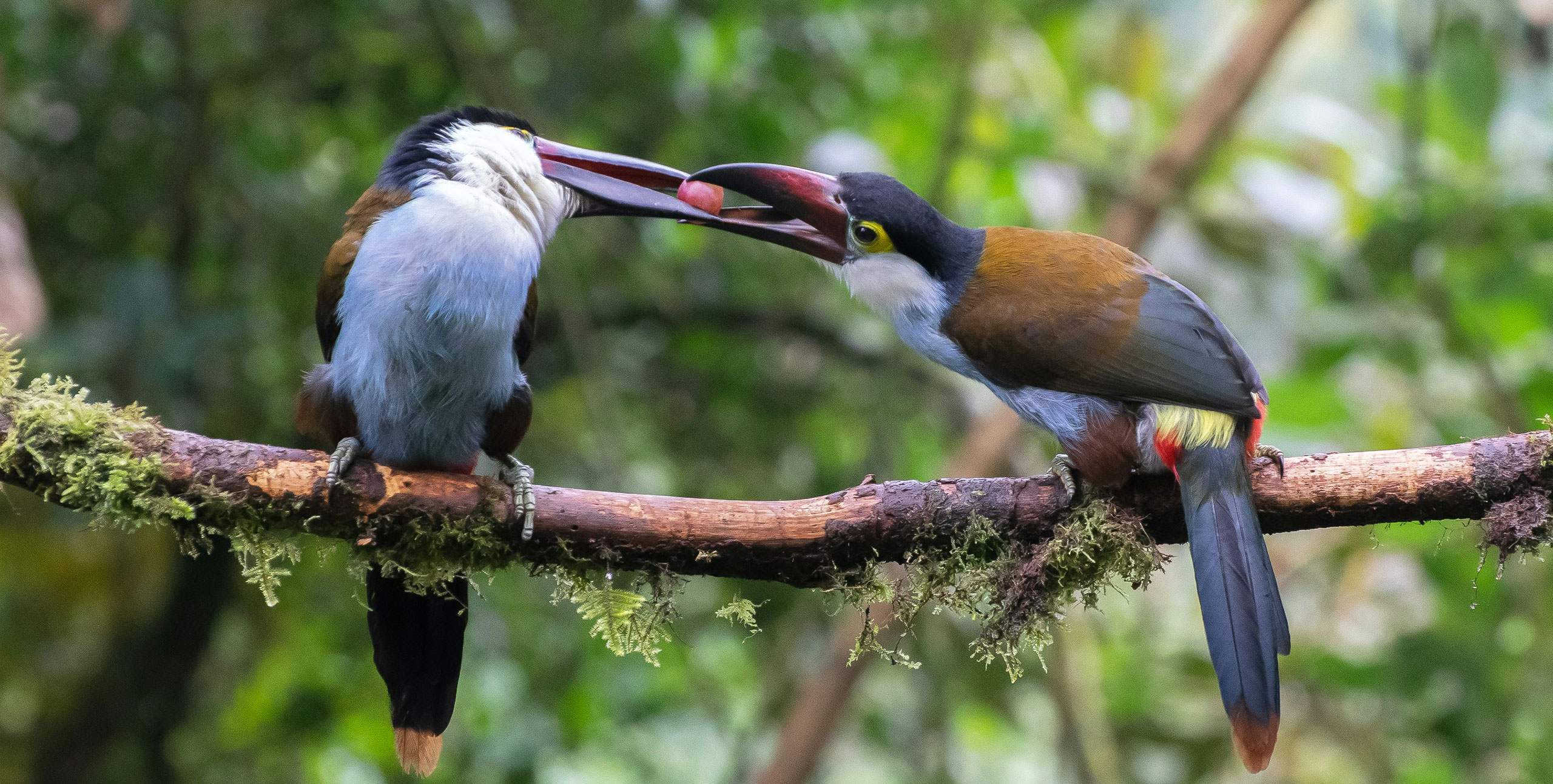
Getting along: Once it is evident they will not fight, it is important that they also get along, which may not be evident for days or even weeks. If they are getting along and like each other, you will notice them sitting close to each other and preening each other. When breeding season arrives you may notice they engage in 'courtship feeding', which involves passing food back and forth. If the birds are not fighting, but continue to avoid each other after many weeks, it is desirable to select different mates for them.
Environment: When a pair apparently gets along, is seen sitting together frequently, but does not breed, perhaps their flight is not satisfactory to them and adjustments should be made, or they should be moved to different quarters.


Housing & Environment
We do not recommend housing breeding pairs indoors, for a multitude of reasons. Toucans benefit greatly from the fresh air, sunshine, and natural environment that they would encounter in the wild. Their health, feather condition, and well-being is unparalleled when housed outdoors, which in turn leads to successful breeding and healthy chicks.
Outdoor Flight Construction
Toucans are territorial birds during breeding season and are very active fliers. It appears, therefore, that the larger the flight, the more likely they are to breed. At Emerald Forest Bird Gardens, we have had excellent success with egg production using the following flight sizes:
Toucans: 12 ft. wide x 24 ft. long x 8 ft. high
Toucanets and Aracaris: 8 ft. wide x 12 ft. long x 8 ft. high
We have found from our experience, as well as other successful breeders, that slightly smaller may suffice, but larger is always better. Flights should have a sheltered area at the rear, extending out 4 ft., to protect the nest and food station from rain or excessive sun, and to provide the birds with shelter from the elements. Additionally, outdoor enclosures should always include a safety aisle – a secondary caged-in area attached to the main aviary door – to help prevent full-flight birds from getting loose when you enter their enclosure. This is essentially a two door system where you enter the outer door and shut it before opening the main door. Flights should be planted with bird-safe, non-toxic trees and shrubs of the appropriate size to provide perching opportunities, shade, and a pleasant, natural environment. Keep overgrowth trimmed to leave space for flying.
Safety: To protect your toucans from predators and intruders such as raccoons and hawks, any exposed sides of the flights (including the floor if the flight is elevated above ground) should be double-wired. The flights need to also be rodent-proof to avoid rodent-borne diseases, as well as secondary kill potential from rodent poison. Monitor your aviary regularly for any potential hazards.
Neighbors: It is clear from years of experience that toucans are more likely to breed if they cannot see their neighbors. To prevent visual contact, we have used a combination of 90% shade cloth overlapping reed fencing. Audio contact does still exist between our flights, suggesting that it is not as important as visual contact. This is consistent with the rainforest, where toucan calls carry some distance, but the forest denseness prevents visual contact.
Weather: Toucans don't tolerate high heat above 95°F without a misting system on top of the flight. They can acclimate to 32°F in the winter if they are introduced into the aviary during a period of mild temperatures between 65-85°F in the warmer season. Keep in mind that toucans are native to a tropical climate, and will need time to adjust to more extreme temperatures. They cannot be put out on a cold wintery day, because the sudden change is too much for them to tolerate, but acclimating them as the season changes works well.
Nesting Materials
Toucans are cavity nesters, which means they nest in tree holes in the wild. They do not make their own hollows, but rather commandeer the nests of woodpeckers and parrots, or utilize the holes formed from branches that have broken off, causing rotting heart wood to create a cavity.
To mimic these natural accommodations, we make a hollow nest using palm tree logs cut into 4 ft. lengths and hollowed out with a chainsaw. Appropriate interior dimensions are as follows:
Toucans: 10-12 in. interior diameter x 18-20 in. depth, with 4 in. diameter entrance hole
Toucanets and Aracaris: 8 in. interior diameter x 18-20 in. depth, with 2 in. diameter entrance hole
The top should be covered with a piece of plywood, enclosing the nest. No additional nesting materials should be put inside – they will simply remove it as they prefer to nest on bare wood. It is also worth noting that traditional wooden nest boxes almost never work.
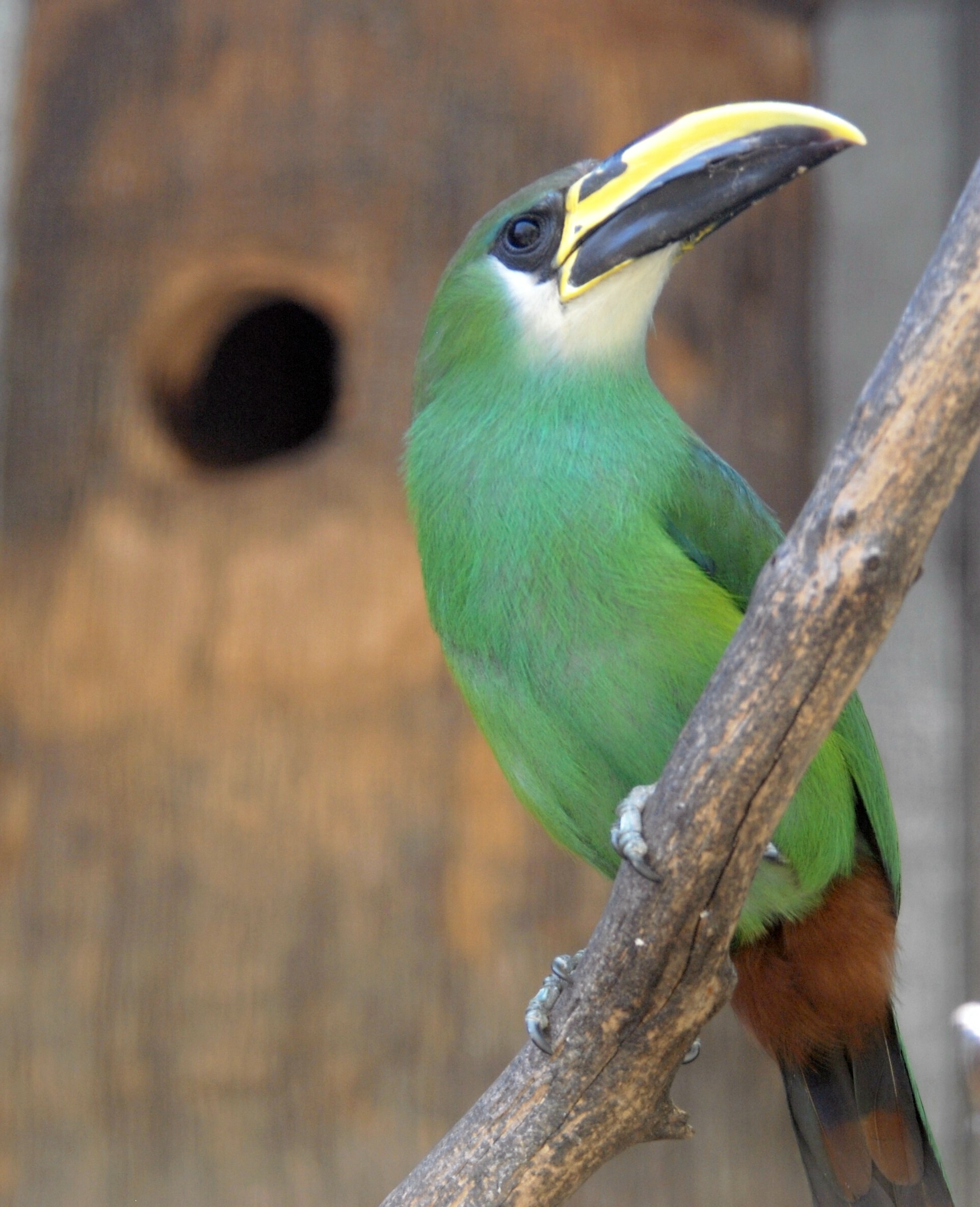
Because breeding season onset varies from one year to the next, and some toucans (particularly aracaris) prefer to roost in these nests during the non-breeding season, the nest logs should remain in place year round. Our logs are placed on a 4 ft. high platform in the corner of the shelter. If space allows, a second nest could be offered to give them a choice, increasing the odds of breeding.
Dietary Requirements
It is not surprising that diet plays an important role in the breeding of toucans. To learn in-depth information about the dietary requirements of toucans in general, visit our Toucan Care page. During breeding season, their dietary needs change due to the physical demands of producing and raising offspring, and the food offered should be altered accordingly.
Toucans are generally considered frugivores, as the vast majority of their diet in the wild consists of fruit. However, they are technically omnivores, and will consume a variety of insects and some small vertebrates or eggs, taken primarily in the breeding season when the protein demands of their offspring are quite high. Because of this, toucans should be given added protein of a similar form just before and during breeding season, to help both meet their needs and encourage them to breed.
At Emerald Forest Bird Gardens, we feed our breeding toucans the standard diet consisting of a varied mix of fresh fruit (typically papaya, cantaloupe, watermelon, honeydew, bananas and blueberries), Mazuri Low Iron Softbill Pellets, and fresh water, plus 2-3 pinky mice cut in half, and sometimes crickets for added protein.
Caring for Offspring
Babies in the nest
When breeding season begins, usually at the beginning of spring, the birds will lay 3 to 4 eggs, or occasionally 2 or 5. Incubation begins when the clutch is complete (the female has laid all the eggs she intends to lay) and lasts for 16 days, though some people have claimed 18 days. Once the eggs hatch, the babies will huddle together, necks intertwined, for the first week or so. At approximately 42 days (give or take 2 days) the babies will begin to fledge. They will be clumsy at first, so they need to be monitored for a few days to make sure none spend the night on the ground. If you find a fledgling on the ground, pick it up and put it back in the nest at least 30 minutes before dark.
Toucans are cooperative breeders, and both the male and female will participate in incubating eggs and raising babies. However, a first-time pair may lack the experience and confidence to handle the challenges of raising a brood and may be more likely to abandon the nest if they encounter disturbances, stress, or simply lack the necessary skills to respond to the chicks' needs. In this case, abandoned eggs may need to be pulled for incubation, and abandoned chicks will need to be pulled for hand-rearing.


Pulling Chicks
If there are problems such as parental neglect, the babies will have to be pulled for hand feeding. Babies may also be pulled for hand feeding if the goal is to raise a pet-quality bird, however, they should ideally be raised by their parents for a minimum of two weeks before pulling to prevent possible developmental issues. Babies pulled from their parents should be immediately weighed for a point of reference. They will appear to lose weight the following day, largely because you were weighing the food they had eaten that day, while the following day you are weighing a bird with no food in its system.
Incubation: Unfledged babies need to be kept warm until their feathers have fully grown in, and should be kept in an incubator until they are ready to fledge. The appropriate temperature varies by age and weight:
Neonates - incubator hatched, or under two weeks old: 95°F
Nestlings - over 40 grams, or older than 2 weeks: 92°F
Substrate: Toucans can develop spraddle leg – a condition where a chick's legs splay out to the sides, preventing them from standing and walking normally – if not given the proper substrate. We recommend placing babies in an appropriate-sized bowl lined with a paper towel and a piece of rubber shelf liner on top, cut to fit. The paper towel will absorb poop and the rubber liner will provide a non-slippery surface for babies' legs to develop properly. Loose bedding should never be used, as babies can inadvertently swallow pieces of it and become ill.
Hand Feeding
Hand feeding toucans is simple but time consuming. Toucans do not have a food-storage crop like parrots do, and need to be fed small amounts of food often. Baby toucans are eager eaters, and are generally very easy to feed. However, if you encounter resistance, never force food on them as this can lead to aspiration (getting food into their lungs) which can lead to illness or death.
Feeding frequency: Babies under 3 weeks of age are fed every two hours from 7 AM to 11 PM, nine times a day. As the birds get older, the number of daily feedings can be reduced, but slowly – never more than one per several days. If the bird does not gain, or if they lose weight, then the number of feedings must go up again.
Tracking weight gain: Babies should be weighed every morning on an empty stomach, before the first feeding of the day, to track daily weight gains. Ideal weight gain for a healthy baby is 10% a day. So, if a baby weighs 10 grams, it should gain 1 gram the following day, weighing 11 grams total. If a baby weighs 100 grams, it should gain 10 grams the following day, weighing 110 grams total. Weight loss can signal that a bird is not receiving enough food, or that it is sick and needs medical attention.
Food preparation: We use Mazuri Ramphastid Hand Feeding Formula, which is formulated specifically for iron-sensitive species, and mix with room temperature distilled water. No heating is required. Food should be mixed to the consistency of pea soup – better a little watery than too thick. However, be careful not to dilute it too much to ensure the bird is receiving enough nutrition with each feeding.
Feeding amounts: We feed toucanets and aracaris from Day 1 through weaning with a one milliliter syringe. The larger toucans can be graduated to a three milliliter syringe once the amount per mouthful warrants the change. The amount of formula per mouthful should equal approximately .08% of the body weight, and feedings should consist of approximately 10 mouthfuls per session. Babies should be allowed to swallow completely between mouthfuls. Do not rush the feeding process. You can observe the food going down the throat into the body, and know when they are ready for more. The following are recommended amounts by weight:
| Body Weight | Amount Per Mouthful | Amount Per Feeding |
|---|---|---|
| 15-30 grams | 0.1 ml per mouthful | 1.0 ml total |
| 30-50 grams | 0.15 to 0.2 ml per mouthful | 1.5 to 2.0 ml total |
| 50-80 grams | 0.3 ml per mouthful | 3.0 ml total |
| 80-120 grams | 0.5 ml per mouthful | 5.0 ml total |
| 120+ grams (toucanets & aracaris) | 1.0 ml per mouthful | 10 ml total (or up to 10% of body weight) |
| 380+ grams (toucans) | 3.0 ml per mouthful | 30 ml total (or up to 10% of body weight) |
Record keeping: We keep detailed records of our babies' development through weaning. This includes daily weight recordings, amount per feeding, and notes on observations of physical or behavioral irregularities. Good recordkeeping can help you identify any issues in development, or medical issues that may need attention, before they become critical.


Recommended Hand Feeding Formula
- Low iron formula – Ideal for iron-sensitive species
- Higher in protein, calcium, phosphorous and vitamins D and A
- Contains probiotics and omega-3 fatty acids
- No supplementation required
Weaning the chicks
Once the babies begin to perch on the side of their container, we move them to a small cage and begin providing an adult diet of diced fruit and Mazuri pellets in a shallow bowl. They will slowly begin to try eating on their own, picking at the food out of curiosity, and may become fussy about receiving formula at this stage. It helps to feed them pieces of fruit and pellets by hand, in between formula feedings, to encourage them to eat on their own. We feed one piece of fruit or one pellet at a time, holding it out in front of their beak, allowing them to take it.
Babies should continue to receive hand feeding formula 2-3 times a day until they are fully eating an adult diet on their own, and are able to sustain their weight for a period of at least two weeks. It is important to continue weighing the babies every day throughout the entire weaning process to ensure they are getting enough food. It takes about 3-4 weeks to fully wean a baby toucan.

