Tiki Toucan

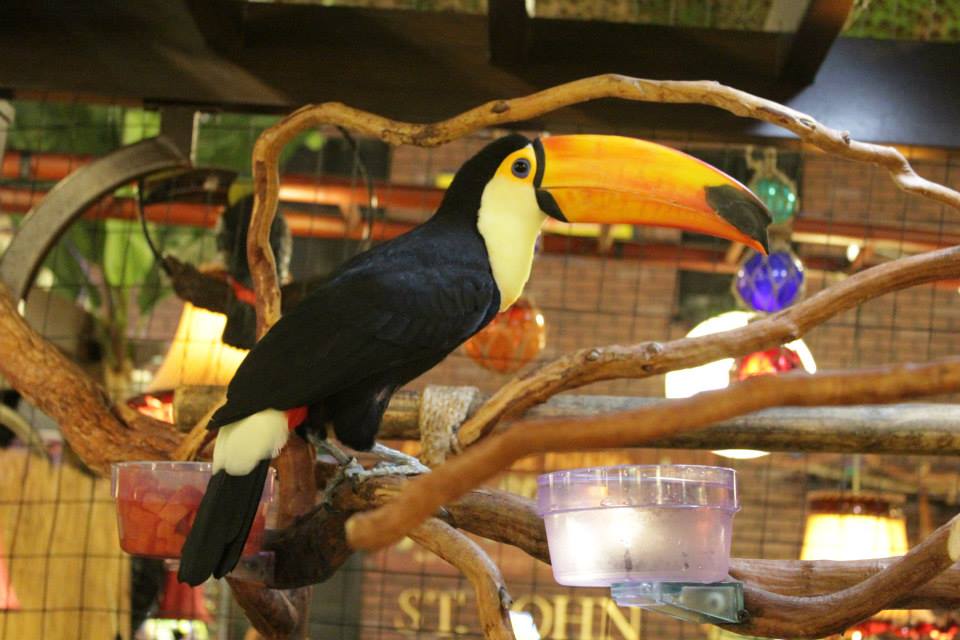
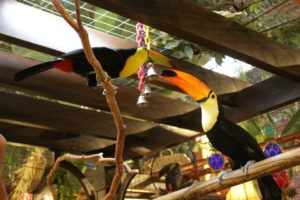
At night as showroom lights dim at the tropical island themed Larry St. John & Co., Tiki Toucan curiously stretches his soft white neck side to side, raises his bright orange beak, hops to the highest corner branch, props up his cute red tail, shuts his majestic blue eyes between tuxedo black feathers at his backside and quickly goes to sleep!

Tiki loves to be hand-fed ripe papaya, usually in ten small squares twice daily and six tiny slices of fresh banana. Tiki likes to catch tossed grapes by opening his beak and roll a grape back and forth inside his beak for fun.

Tiki drinks fresh water from two plastic bowls, eats forty small red seedless grapes and twenty blueberries from a third bowl, and a hearty handful of tiny Mazuri softbill pellets from a fourth bowl each day.
Tiki tilts his head sideways, slides his beak upward through a large birdbath bowl of fresh water to clean his beak, then jumps in the middle and flaps his wings to bathe.

Tiki playfully hops and flies to comfy branches in his jungly patio and excitedly croaks while watching friend Johnny, the “five-ring swinging” Blue and Gold Macaw perched on an open habitat of three-story tree branches at the front counter fifteen feet away.

Tiki happily hops down to greet children and gently clasps food by the tip of his beak.

Tiki flies up close to greet Johnny who rides on rings to visit. Tiki’s warm personality influences Johnny to calmly interact. The Toucan mesmerizes the Macaw!
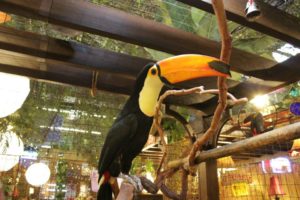
Thanks to Jerry Jennings and Emerald Forest Bird Gardens, our dream of sharing life with a Toucan in sunny Southern California has come true!

James Robert Reade
Larry St. John
Gardena, California, USA


Costa Rica

Costa Rica is one of my favorite countries in the world. It has been a travel destination for me for more than 20 years. I own a 200 acre piece of property on the beach near Golfito, and visit Costa Rica several times a year where I also have friends. I support the Toucan Rescue Ranch and its activities in wildlife conservation and rescue.

I have visited every corner of the country and observed and photographed its myriad wildlife species. Wildlife species which include all six-species of toucans native to the country: Keel-billed Toucan, Chestnut-mandibled Toucan, Collared Aracari, Fiery-billed Aracari, Emerald Toucanet and Yellow-eared Toucanet.

Costa Rica is perhaps the only country without a military and the government devotes its resources to providing free medical care and education to its people, making it one of the world’s friendliest countries. It is also home to a large expat community of Americans and Europeans.

Some of my favorite places to visit within Costa Rica are Manuel Antonio and its pristine beaches and crystal-clear water, Monteverde and its cloud forest and abundance in wildlife, Arenal and its majestic volcano, Dominical and its wonderful surf and Tortuguerro and its beautiful turtles. While in these places I really enjoy birding.

The food in Costa Rica is good especially for seafood lovers and the national drink, guanabana is delightful.


Galapagos and Ecuador

A bucket list destination, the Galapagos inspired Charles Darwin to develop his theory of natural selection. This group of islands are primarily a desert environment – each containing its own species of land tortoise, which are highly endangered, including the largest tortoise in the world. The Galapagos is also home to a variety of iguanas including the famous marine iguana and the northern most penguin species. They contain a wide variety of birds including three species of Boobies: the blue, black and red footed, and the Frigatebird, all of which are fearless. These birds’ nests are close to the ground because there are very few trees. We were on the islands for 2 weeks and then headed to mainland Ecuador.

Frank Todd and I visited northwestern Ecuador, where we saw Plate-billed Mountain Toucans, Crimson-rumped Toucanets, Pale-mandibled Aracaris, Toucan Barbets, Wattled Umbrella Birds and a variety of tanager and hummingbird species.

The mountains are very cool so be sure to bring your sweater or jacket.


Madagascar

Frank Todd, a good friend of mine, and I went to visit Madagascar to try and find the elusive Madagascar Pochard. We stayed in a park called Ankrafantsika National Park in Northern Madagascar. This is where we met two vets named Hannah and Mai. They were researching lemurs. The vets were taking tissue, fur, blood and fecal samples. Also, measuring the animals and radio-collaring some to track. We stayed watching the lemurs and learning about the study for a week.

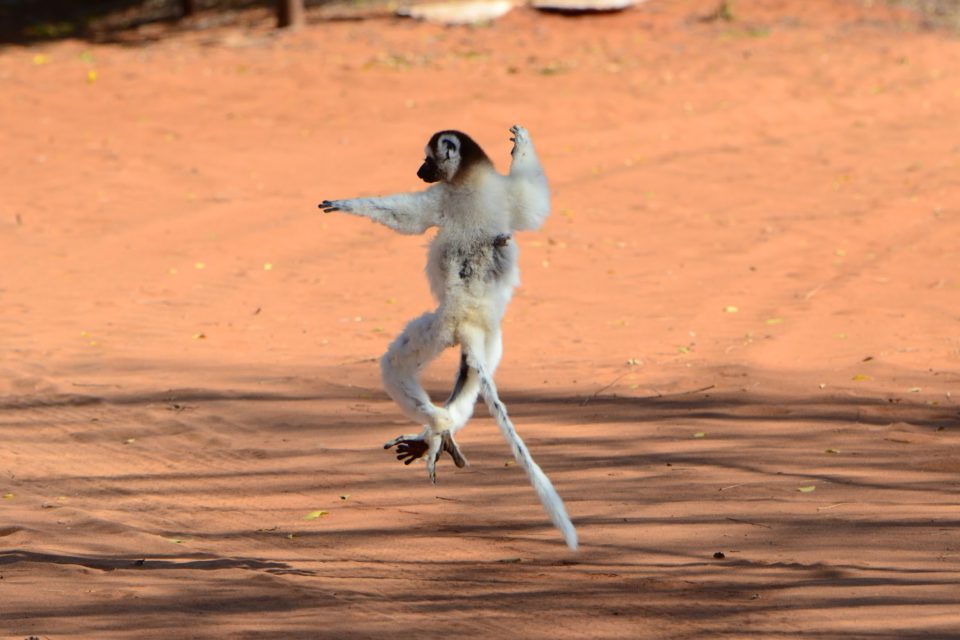
Then, we went to a breeding facility for the Madagascar Pochard, the world’s rarest duck, south of the park, and stayed a couple of days taking pictures. Frank took roughly 2,000 photos of the duck! I only took 100. He was a photo fanatic. In Madagascar, we found a lot of wildlife, most of them being lemurs and some being birds such as bee-eaters and ducks. We finally made it south to the other end of the island and discovered the dancing Sifaka and Ring-tailed Lemurs. The babies wrap their tails around their mother’s stomach.

Unfortunately, Frank and I discovered the severity of deforestation in the country. It is probably the worst I have ever witnessed. Despite the dire environment there are still 116 different types of lemurs in the wild. In total we were in Madagascar for 2 weeks and I highly recommend the trip.


Antarctica

A trip of a lifetime to Antarctica in January of 2012 with G Adventures, Frank Todd and I spent 3 weeks beginning in the Falkland Islands, and moving to an island called South Georgia. We spent over a week cruising through this area, then headed to the Antarctic peninsula. We saw a total of 8 species of Antarctic penguins: the King, Adele, Gentoo, Rockhopper, Macaroni, Chinstrap and Magellanic. We saw Humpback whales, Fin whales, and several species of seals including the Leopard and Southern Fur. We also saw a variety of birds including the Skua, Giant Petrel and Johnny Rooks.

Fortunately, the weather was nice because we went during the Antarctic summer. The crew members were friendly and we really enjoyed our time. It was one of my favorite trips I’ve been on, and I’ve been to 75 countries!


The Arctic

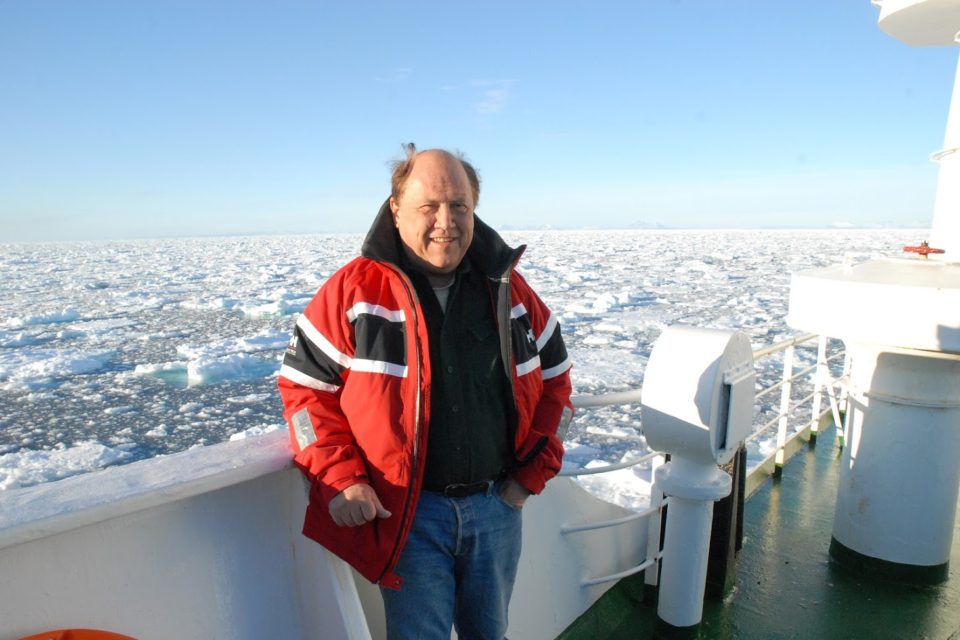
Frank Todd and I took a Polar Expedition to the Arctic that included a stop in Svalbard, the northernmost inhabited place on the planet, where we saw polar bears, seals, whales and a variety of seabirds including Kitiwakes. From Svalbard, we sailed west to Greenland and down the entire east coast, visiting an Inuit village at the mouth of the world’s largest fjord, finally ending up in Iceland.

We spent 1 week in Reykjavik, rented a house and explored the island. We also had the pleasure of seeing puffins and many ducks such as the Harlequin as well as the Iceland pony. No one is allowed to import other horses because they do not want them to interbreed with the Iceland pony.

The restaurants in town offered many of the birds we enjoyed seeing in the wild such as: Puffins, Guillemot, and Short-billed Murres as well as a variety of different whale species. The landscape is devoid of trees, it was all grasslands. Iceland is a volcanic island with many hot springs and steam vents. Most of their electricity comes from geothermal activity. Iceland straddles the mid-Atlantic ridge and you can see the split, which is funny, because part of the island is moving east and the other moving west.

The people were very friendly and beautiful. I believe it’s because they’ve lived there uninfluenced by other ethnicities. I would do this again – a trip recommended for an adventurer.